One-Page Website or Full Website? What Small Businesses Actually Need
A one-page website sounds tidy.
One page. One message. One simple place to send people.
For some small businesses, that is enough. For others, it quietly limits how many people find them, how much trust they build, and how clearly they explain what they do.
The trick is not asking which option is trendy. The better question is this:
Do people already know you, or do you need the website to help them find and trust you?
When a one-page website can work
A one-page website can be a good fit when the business is simple and the goal is clear.
For example, it can work for a solo consultant, a small event, a landing page, a campaign, or a business that gets most of its leads through referrals.
If someone already knows your name and just needs your phone number, proof, services and contact details, one strong page can do the job.
It can also be useful as a short-term website while a fuller site is being planned.
Simple is not bad. Simple is only bad when it hides important information people need before they enquire.
Where one-page websites run into trouble
The problem with a one-page site is that it asks one page to do too much.
One page may need to explain every service, every location, every proof point, every FAQ, every call to action and every reason to trust the business.
That can get crowded fast.
It also makes SEO harder.
Google needs clear signals about what each page is about. If your only page talks about web design, SEO, Google Ads, WordPress support, ecommerce and ten different suburbs, it becomes a bit of a soup.
A tasty soup, maybe. But still a soup.
Why multi-page websites usually help SEO
A full website gives each important topic its own place.
You can have a page for each core service. You can create pages for common questions. You can explain different types of work without jamming everything into one scroll.
That helps users because they can land on the page that matches their problem.
It helps Google because each page has a clearer topic.
For example, a Gold Coast service business might need separate pages for:
- Main service overview
- Specific services
- Locations or service areas
- Case studies
- FAQs
- Pricing guidance
- About and trust information
- Contact or booking
Not every business needs all of that. But if those topics matter to buyers, they probably deserve more than one rushed paragraph on a homepage.
Trust is easier when people can explore
People rarely enquire the second they land on a website.
They look around. They check whether you understand their problem. They compare. They look for signs that you are real.
A full website gives them more to work with.
Service pages explain fit. Case studies show proof. FAQs answer objections. About pages add a human layer. Blog posts help before the sales call.
A one-page site can still build trust, but it has less room to do it.
What about mobile users?
Some people choose a one-page site because they think mobile users hate clicking.
That is not quite right.
Mobile users hate friction. They do not hate useful pages.
If the navigation is clear and the content is helpful, moving between pages is fine. What annoys people is digging through a giant page trying to find one specific answer.
Sometimes more pages make the mobile experience easier, not harder.
Use a one-page website if...
- You have one main offer
- You mostly get referrals
- You need something simple and fast
- You do not rely heavily on SEO
- You only need a proof page for people already checking you out
- You are testing a new idea before building a bigger site
Use a full website if...
- You want to rank for more than one service
- You serve different customer types
- You want local SEO to work harder
- You need to explain your process
- You have proof, case studies or FAQs worth showing
- Your buyers compare you against other businesses
- Your current site feels too vague or thin
The middle ground
You do not always need a huge website.
For many small businesses, the sweet spot is a lean multi-page site.
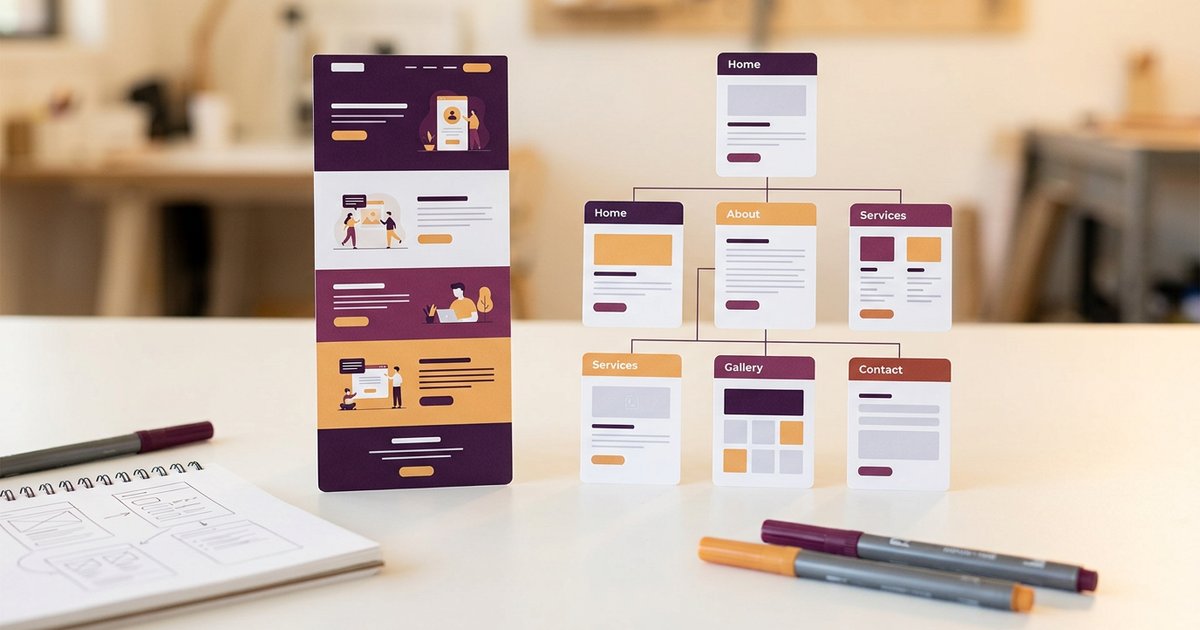
That might mean a homepage, a few service pages, an about page, proof, FAQs and contact. Enough structure to support SEO and buyer confidence without creating a bloated content maze.
Start with the pages that match real customer questions.
If people keep asking “do you do this?”, that may need a page.
If people keep asking “how much does this cost?”, that may need a page too.
If nobody cares, do not make a page just to look busy.
So, which one should you choose?
If your website only needs to support referrals, a sharp one-page site may be enough.
If you want the website to attract new leads from Google, explain multiple services, build trust and answer objections, a full website is usually the better move.
The real answer depends on how your customers buy.
Spray Media helps small businesses plan websites around search, trust and enquiries, not just page count.
Because “one page or five pages?” is less important than “will this help the right person contact you?”

Written by
Mark SprayMark is the founder of Spray Media, a Gold Coast web design and digital marketing agency. With over 100 projects delivered and consistent 5-star reviews, he helps small businesses and tradies get more customers through websites that actually rank on Google. Before Spray Media, Mark built a national weighted blanket company recognised in Australian Parliament for its community employment initiatives.