How Long Does a Website Redesign Take for a Small Business?
The honest answer is: it depends
Most small business owners ask this question expecting a simple answer. The truth is, a website redesign can take anywhere from four weeks to five or six months. The difference usually comes down to a handful of factors that are entirely within your control.
Understanding what drives the timeline helps you plan better, set realistic expectations with your team, and avoid the most common delays.
What actually affects the timeline
Scope of the project
A five-page brochure site is a very different job to a 30-page site with a blog, booking system, and e-commerce. The more complex the functionality, the longer it takes to build and test properly.
For a more straightforward small business site, the timeline is usually shorter because there are fewer moving parts and fewer rounds of testing.
Content readiness
This is the single biggest cause of delays. If your copywriting, photos, and brand assets are not ready when the designer needs them, the project stalls. Most designers cannot finish a website with placeholder text and stock images.
How quickly decisions get made
If approvals need to go through multiple people or a business owner who travels frequently, feedback rounds take longer. A project that could finish in six weeks can stretch to three months simply because of slow sign-offs.
Platform and custom requirements
Building on a well-supported platform like WordPress or Squarespace is generally faster than a fully custom build. Custom integrations, databases, or third-party software connections add time to any project.
Typical phases and rough timeframes
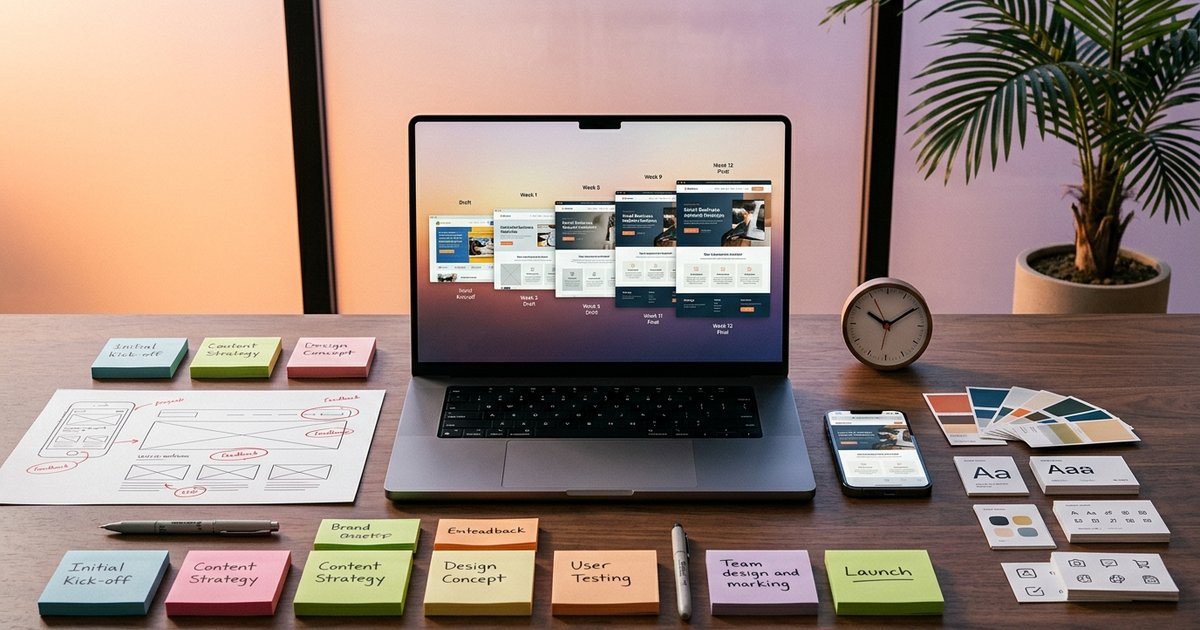
- Discovery and strategy (1 to 2 weeks): This covers your goals, target audience, site structure, and technical requirements. Skipping this phase leads to expensive changes later.
- Design (2 to 4 weeks): Mockups and visual concepts are created, reviewed, and refined. Expect at least two rounds of revisions.
- Development (2 to 6 weeks): The approved design gets built out. Time varies significantly based on features and integrations required.
- Content population and testing (1 to 2 weeks): Real content goes in, everything gets tested across devices and browsers, and final tweaks are made.
- Launch and post-launch (1 week): The site goes live, redirects are set up, and any immediate issues are resolved.
For a straightforward small business site, you are looking at roughly eight to twelve weeks from kick-off to launch. More complex projects sit in the three to five month range.
What speeds a project up
- Having your copy written before the project starts
- Providing high-quality photos and brand assets upfront
- Having one clear decision-maker who can give feedback quickly
- Knowing what you want before briefing your designer
- Choosing a platform your designer knows well
What slows a project down
- Changing the scope mid-project (adding new pages or features)
- Slow feedback rounds or feedback from too many people at once
- Needing to create content from scratch during the build
- Unclear goals or conflicting opinions on direction
- Waiting on third-party suppliers for integrations or assets
Scope creep is particularly costly. Adding a new feature halfway through development can push your launch date back by weeks and increase your budget significantly.
How to prepare so you are not the bottleneck
Before your project even starts, get your content sorted. Write your page copy, gather your best photos, and have your logo files ready in vector format. If you need help with copywriting, budget for it and get it done before the design phase begins.
Nominate one person internally to be the point of contact for the project. Feedback from five different people with conflicting opinions is one of the fastest ways to derail a timeline.
Set aside time in your calendar for feedback rounds. Your designer will need responses within two to three business days to keep momentum going. If you know you have a busy period coming up, flag it early so the project can be scheduled around it.
Finally, be clear on your must-haves versus nice-to-haves before you start. If budget or time gets tight, you will know what to cut without compromising the core of the project.
Set realistic expectations from the start
A website redesign is a proper project, not a quick fix. Rushing it to meet an arbitrary deadline usually results in a site that underperforms or needs rework sooner than expected.
If you are planning a redesign, start by mapping out your content and setting a realistic launch window. Give yourself buffer time for feedback rounds and unexpected delays.
Ready to get started? Get in touch and we can talk through your goals, scope, and a timeline that actually works for your business.

Written by
Mark SprayMark is the founder of Spray Media, a Gold Coast web design and digital marketing agency. With over 100 projects delivered and consistent 5-star reviews, he helps small businesses and tradies get more customers through websites that actually rank on Google. Before Spray Media, Mark built a national weighted blanket company recognised in Australian Parliament for its community employment initiatives.